
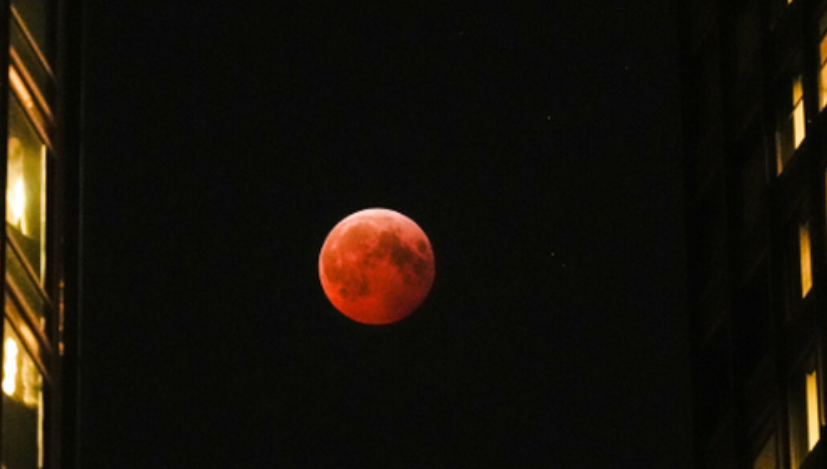
On March 3rd, skywatchers around the world will have the opportunity to witness one of the most spectacular astronomical events of the year — a total lunar eclipse, often referred to as the “Red Moon.” This celestial phenomenon occurs when the Earth passes directly between the Sun and the Moon, casting a shadow that gradually darkens the lunar surface before transforming it into a dramatic reddish glow.
A total lunar eclipse happens only during a full moon, when the alignment of the Sun, Earth, and Moon is nearly perfect. During this event, the Moon moves into the Earth’s shadow, known as the umbra. Instead of disappearing completely, however, the Moon takes on a copper or blood-red color. This striking transformation is caused by Earth’s atmosphere bending and filtering sunlight.
The science behind the “Red Moon” is both simple and fascinating. As sunlight passes through Earth’s atmosphere, shorter wavelengths of light (such as blue) are scattered in all directions — the same reason why the sky appears blue during the day. The longer wavelengths, particularly red and orange light, pass more directly through the atmosphere and are refracted, or bent, toward the Moon. This filtered light bathes the lunar surface in a warm, reddish hue.
This particular eclipse is especially notable because it coincides with the first full moon of spring in the Northern Hemisphere, making it symbolically significant as well as scientifically intriguing. Lunar eclipses have fascinated civilizations for thousands of years, often inspiring myths, legends, and cultural rituals. Today, they provide not only a beautiful spectacle but also valuable scientific insight into Earth’s atmosphere and orbital mechanics.
Where and when can it be seen?
The total lunar eclipse will be visible from many regions that are on the night side of the Earth during the event. This includes large portions of North and Central America, Australia, the Pacific region, and East Asia. Viewers in these areas will be able to observe the eclipse in its entirety, provided weather conditions cooperate.
Unlike solar eclipses, lunar eclipses are completely safe to observe with the naked eye. No special glasses or equipment are required. However, binoculars or a small telescope can significantly enhance the experience, allowing observers to see greater detail in the Moon’s surface as it changes color.
Clear skies are essential for the best viewing experience. Cloud cover or atmospheric haze may partially or completely obscure the event. For that reason, many astronomy enthusiasts monitor local weather forecasts in advance to find the best possible viewing location.
The stages of the eclipse
A total lunar eclipse unfolds gradually over several hours. It begins with the penumbral phase, when the Moon enters the outer part of Earth’s shadow, causing a subtle dimming. Next comes the partial phase, as the Moon moves deeper into the shadow and a noticeable “bite” appears on its surface. Finally, during totality, the Moon is fully immersed in the Earth’s umbra and glows red.
The exact shade of red can vary depending on atmospheric conditions. Dust, pollution, or volcanic particles in Earth’s atmosphere can intensify or darken the reddish coloration. In some cases, the Moon may appear bright orange; in others, it can look deep crimson or even brownish.
How to watch the eclipse live
For those who are unable to see the eclipse directly due to poor weather or geographical limitations, there are numerous online options available. Major observatories and space organizations often provide free live broadcasts through streaming platforms and official websites.
For example, space agencies such as NASA frequently offer live coverage and expert commentary during major astronomical events. Additionally, observatories and research institutions worldwide may host their own live streams, sometimes including high-resolution telescope views and scientific explanations in real time.