
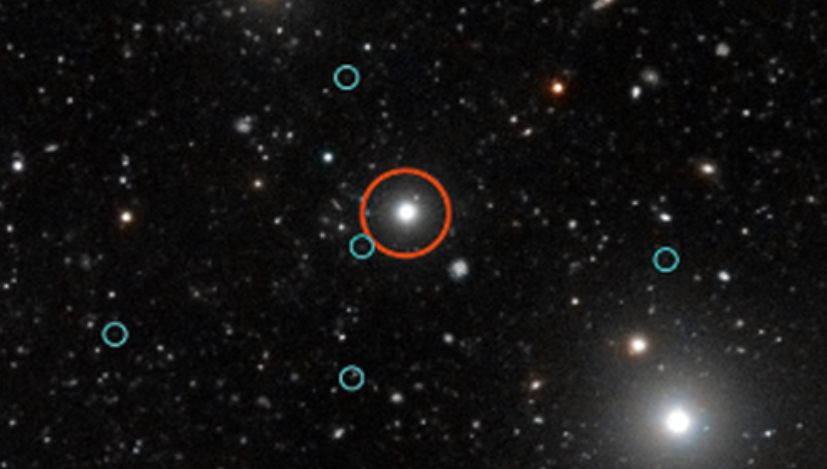
Astronomers using the legendary Hubble Space Telescope have identified one of the most unusual galactic objects ever observed: an extremely faint galaxy that appears to be made almost entirely of dark matter, with only a handful of visible stars. The discovery offers a rare glimpse into one of the universe’s greatest mysteries — the invisible substance believed to make up most of its mass.
The newly identified galaxy, known as CDG-2, lies hidden within the massive Perseus Cluster, approximately 300 million light-years away from Earth. The Perseus Cluster is one of the most massive known objects in the universe, containing thousands of galaxies bound together by gravity. Amid this crowded cosmic environment, CDG-2 stands out not for its brightness — but for its extreme faintness.
Unlike typical galaxies filled with billions of shining stars, CDG-2 is classified as an ultra-diffuse galaxy. It shines with a luminosity equivalent to only about six million Moons combined — extraordinarily dim compared to galaxies like the Milky Way, which contains hundreds of billions of stars. In fact, if CDG-2 were placed at the same distance as nearby galaxies, it would still be incredibly difficult to detect with conventional methods.
What makes CDG-2 particularly fascinating is how it was discovered. Instead of being detected through its starlight, astronomers identified it by observing a compact grouping of four globular star clusters. Globular clusters are dense spherical collections of ancient stars that orbit galaxies. These clusters acted as indirect signposts, hinting at the gravitational presence of a much larger, nearly invisible galactic structure behind them.
Further analysis revealed something astonishing: roughly 99% of CDG-2’s mass appears to consist of dark matter. Dark matter does not emit, absorb, or reflect light, making it completely invisible to telescopes. Scientists can only detect its presence through its gravitational effects — such as how it influences the motion of stars and galaxies around it.
The existence of a galaxy dominated so heavily by dark matter provides important clues about how galaxies form and evolve. In most galaxies, visible matter — stars, gas, and dust — plays a significant role in their structure. However, CDG-2 seems to be almost entirely controlled by dark matter’s gravitational framework, with only minimal stellar content.
Dark matter itself remains one of modern astrophysics’ biggest unsolved puzzles. Although it is believed to account for about 85% of the total matter in the universe, its true nature is still unknown. It does not interact with electromagnetic forces, meaning it cannot be seen with optical, radio, or X-ray telescopes. Yet without it, galaxies as we know them could not exist — their stars would not have enough gravitational binding to stay together.
The discovery of CDG-2 also raises intriguing questions about how such a galaxy formed. One possibility is that it once contained more stars but lost much of its visible matter through gravitational interactions within the dense environment of the Perseus Cluster. Another theory suggests it may have formed in a way that prevented significant star formation from occurring in the first place.
Ultra-diffuse galaxies like CDG-2 challenge traditional models of galactic evolution. Some appear to be “failed galaxies” that never accumulated enough gas to create stars efficiently. Others may be remnants of past cosmic collisions. Each discovery adds a new piece to the puzzle of understanding how dark matter shapes the universe on large scales.
Observations from Hubble continue to demonstrate the telescope’s importance even decades after its launch. By capturing faint light from distant cosmic structures, it allows astronomers to push the boundaries of what can be detected and studied. CDG-2 serves as a reminder that the universe still holds many hidden structures, invisible to the naked eye yet fundamental to cosmic evolution.
As research continues, astronomers hope to use future telescopes and more advanced instruments to study galaxies like CDG-2 in greater detail. By examining their motion, structure, and surrounding environments, scientists aim to refine theories about dark matter and perhaps one day uncover its true nature.
For now, CDG-2 stands as one of the clearest examples of a galaxy dominated by the unseen — a vast, ghostly structure where gravity speaks louder than light, and where the invisible architecture of the universe quietly reveals itself.